The next big Ubuntu feature will be voice dictation
Canonical has announced "Myna" which will convert your speech into text with the push of a keyboard shortcut on Ubuntu desktop.


Canonical revealed this week details for a major new feature planned for the next Ubuntu Linux release this fall. It's text-to-speech dictation built into the desktop environment and it'll be called "Myna."
Introducing "Myna" speech-to-text
In an Ubuntu community forum post, Ubuntu desktop developer Jean Baptiste Lallement formally announced "Project Myna" which will bring text-to-speech dictation to Ubuntu 26.10. The project, aiming to improve Ubuntu's accessibility, is named after the myna, a bird known for its ability to imitate human speech.
There's no early release of Myna to try yet, but the announcement describes a keyboard shortcut activating an always-on audio server that will then start recording and processing any speech it hears through the microphone. It will type in whatever text field you put your cursor in, and when you deactivate Myna, it will stop listening.
 Canonical Ubuntu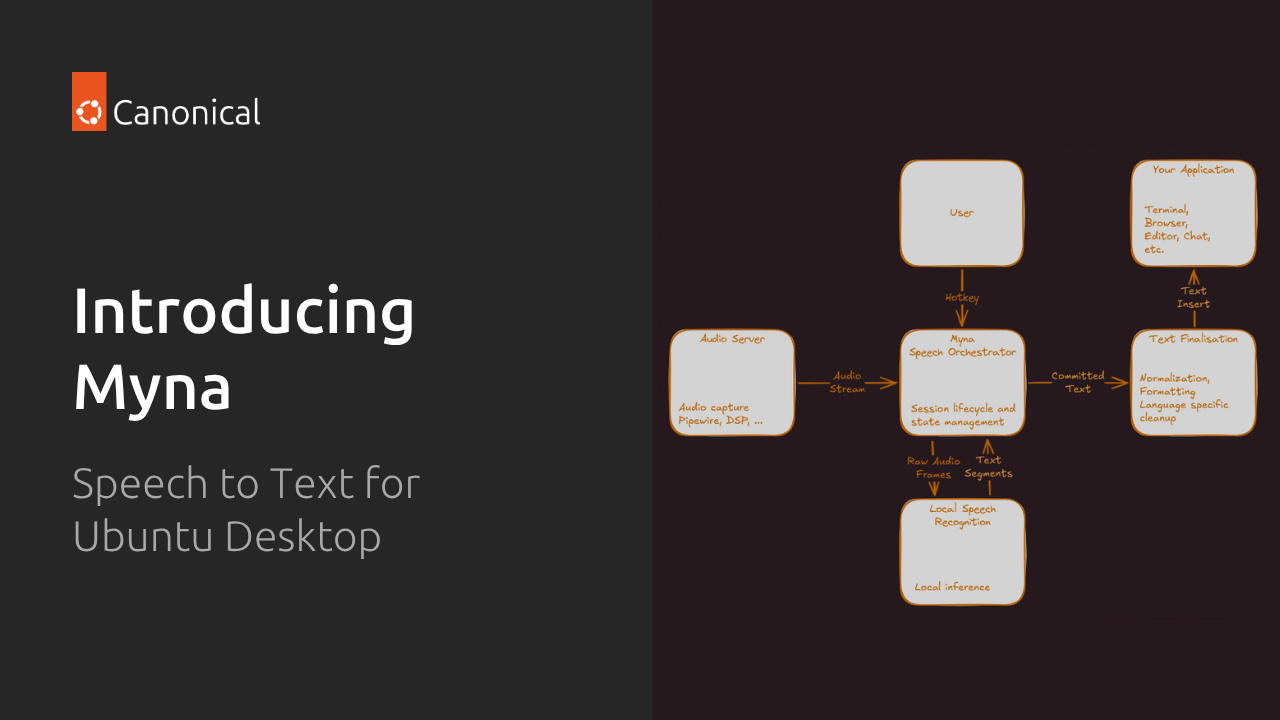
What about privacy? Canonical is framing Myna as a privacy-first feature. The initial release will only work with models that you will need to download directly to your Ubuntu desktop. Once downloaded, there's no need for an internet connection for the dictation feature to work, as it doesn't connect to any outside services. Recorded audio is deleted from memory as soon as it's processed.
- However, the forum post hints that connecting to remote dictation services with Myna may be possible in the future. When you use remote servers to perform dictation, it gets a lot harder to control your data.
GNOME haters will have to wait: At first, Myna will only integrate with the GNOME desktop environment. Other popular desktop environments like KDE and Xfce can expect support later on.
The background: Myna is actually the first fruits of Canonical's plan to integrate AI into Ubuntu announced in April. That forum post had in fact hinted at speech-to-text accessibility features.
For those wanting more insight on the name's origin, plus maybe a laugh, the video below shows a pet myna bird copying its owner's phrases, laughing, and imitating other birds.
Zooming out
Why this announcement matters: Ubuntu is maybe the most well-known Linux distribution out there, making it influential in the open source operating system scene. Major new features have a way of setting standards and expectations for other distros.
Lingering questions:
- How far will these AI projects go?
- The forum post indicates that more advanced "AI" features, while not planned, may eventually arrive, saying "Features such as voice assistants, voice commands, desktop control, translation and automatic language detection are outside the scope of the initial project."
- Which models will Myna's interface let you download, and will they definitely be trained on legally-obtained audio?
- If models are truly open source, you should be able to inspect the training content and ensure nothing copyrighted or illegal is present.
My take: I'm skeptical of features carrying the "AI" label, which has become an overused marketing term at this point. It's weighed down by connotations of shoddy work and overhyped usefulness. Speech recognition models, though, have been around for longer than ChatGPT, and given how many times I've heard people ask for speech-to-text on Linux, I'm kind of surprised it took Canonical this long.
Diving in
Go further: See the forum post on Ubuntu's Discourse to read about it for yourself. You can also review Myna's GitHub repository, which currently holds only some technical specifications rather than any downloadable software.